
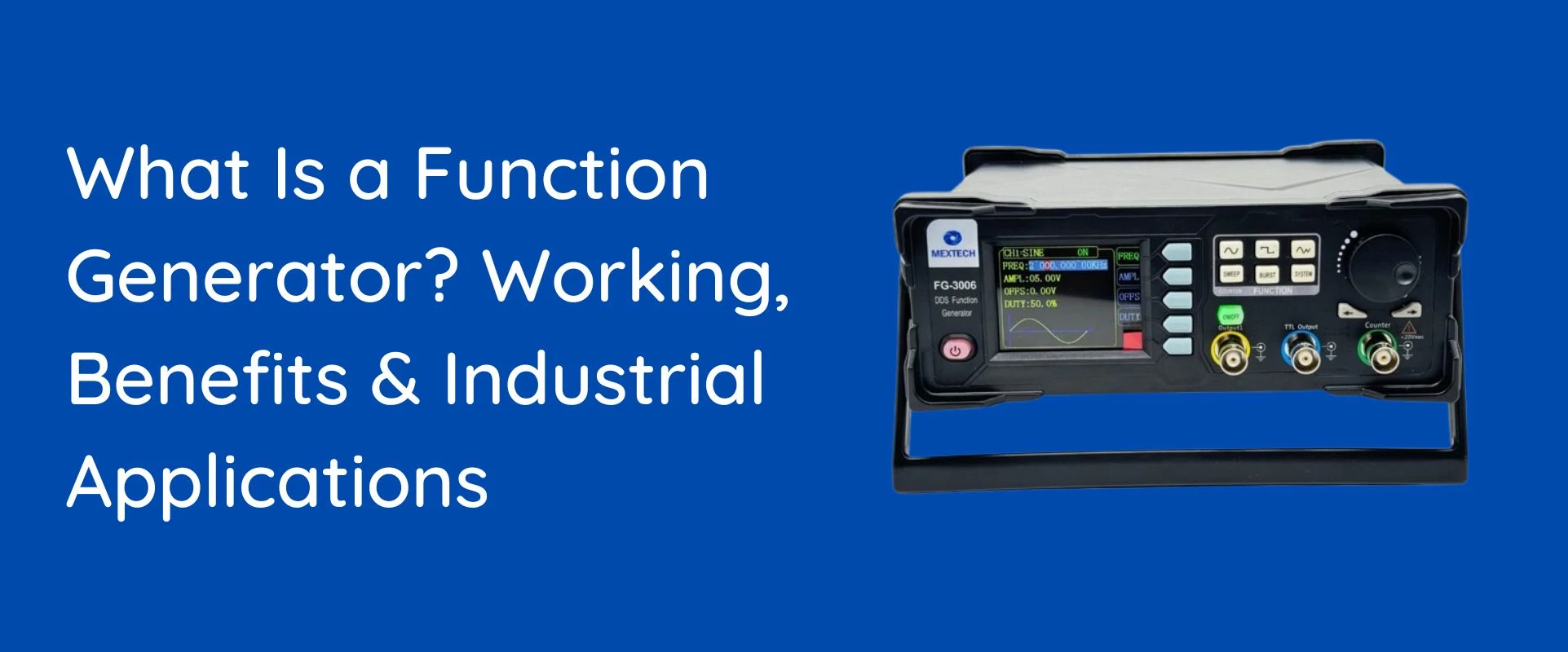
Testing and measurement instruments are essential for designing, developing, and validating modern electronic systems. Among all the tools used in labs, manufacturing plants, and research centers, the Function Generator holds a special place due to its ability to simulate electrical waveforms for testing circuits.
Whether you are an electronics engineer, a student, a quality control inspector, or an R&D professional, understanding how a function generator works can significantly improve the precision and performance of your testing processes. In this detailed guide, Mextech explains what a function generator is, how it operates, its different types, benefits, features, and wide industrial applications.
What Is a Function Generator?
A Function Generator is an electronic test instrument used to generate different electrical waveforms across a wide range of frequencies. These signals are used to test, analyze, and troubleshoot electronic circuits and components.
The most commonly generated waveforms include:
- Sine wave
- Square wave
- Triangular wave
- Pulse wave
- Ramp wave
- Arbitrary waveforms (in advanced models)
Function generators are essential in applications where a stable, repeatable signal is required for:
- Circuit testing
- Frequency response analysis
- Component evaluation
- Education and laboratory experiments
- Digital system testing
In short, they are foundational tools in electronics.
How Does a Function Generator Work?
A function generator uses electronic circuits and signal processing methods to create periodic waveforms. While different models may use different internal mechanisms, the general working principle includes the following phases:
1. Frequency Generation
The heart of a function generator is its frequency generation system.
Older analog function generators use:
- Wien Bridge Oscillator
- RC Circuits
- Current-controlled oscillators
Modern digital function generators use:
- Direct Digital Synthesis (DDS)
- Microprocessors
- Phase accumulator circuits
DDS-based function generators produce highly accurate and stable frequencies.
2. Waveform Shaping
Once the base signal is created, waveform shaping circuits convert basic oscillations into desired signal shapes.
Examples:
- Integrators convert square waves into triangle waves.
- Threshold detection creates pulses from sine waves.
- Mixing circuits create complex waveforms.
3. Signal Amplification
The generated signal is amplified or attenuated depending on the required amplitude.
Users can adjust:
- Output voltage
- Frequency
- Duty cycle
- Phase
- Offset
4. Output Section
The final waveform is delivered through the output terminals for connection to test circuits using probes.
The output impedance is typically 50 ohms, ensuring accurate signal transfer.
Types of Function Generators
Function generators come in multiple varieties based on technology, waveform capabilities, and applications.
1. Analog Function Generators
- Use traditional analog oscillators
- Simple and reliable
- Cost-effective
- Best for basic lab experiments
2. Digital Function Generators
- Use Direct Digital Synthesis
- Highly accurate
- Stable signals
- Wide frequency range
- Ideal for modern electronics
3. Arbitrary Waveform Generators (AWG)
- Generate user-defined waveforms
- Used in high-level R&D and communication testing
4. Sweep Function Generators
- Automatically vary frequency
- Useful for frequency response testing of filters, speakers, and circuits
Key Features of a Modern Function Generator
When you choose a high-quality function generator from Mextech, you get access to advanced features designed for high precision and industrial reliability.
✓ Wide Frequency Range
Ideal for low-frequency and medium-frequency testing needs.
✓ Multiple Waveform Outputs
Sine, square, triangle, pulse, and more.
✓ Frequency Accuracy & Stability
Digital circuits ensure stable, accurate, noise-free output.
✓ Adjustable Output Voltage
Controls amplitude for different test requirements.
✓ Duty Cycle Control
Adjust pulse-width for digital signal simulation.
✓ Frequency Sweep Function
Useful for analyzing the behavior of circuits over frequency changes.
✓ Modulation Options
FM, AM, and phase modulation (in advanced models).
✓ Overload Protection
Prevents damage to connected circuits.
Benefits of Using a Function Generator
A function generator is indispensable for anyone working with electronics. Here are the top benefits:
1. Helps Diagnose Circuit Behavior
By injecting known signals into a circuit, you can observe how it responds and identify faults easily.
2. Provides Accurate Electrical Simulation
Function generators mimic real-world electrical signals to test performance under various conditions.
3. Supports Prototyping & R&D
Engineers use it to validate designs, test components, and fine-tune circuits in early development stages.
4. Useful for Teaching & Learning
Electronics labs in schools, colleges, and training centers rely heavily on these tools for hands-on learning.
5. Cost-Effective Testing Solution
Instead of buying multiple instruments, one function generator can simulate many types of waveforms.
6. Enhances Predictive Maintenance
Industries use function generators to identify deteriorating components by observing how they respond to generated signals.
7. Works Across Multiple Sectors
From telecommunications to consumer electronics and automotive systems, function generators serve wide industrial needs.
Industrial Applications of Function Generators
Function generators are used across numerous industries due to their ability to produce stable, precise waveforms.
1. Electronics Testing & Design
- Testing amplifiers, filters, sensors
- Simulating input signals
- Analyzing frequency response
2. Manufacturing Quality Control
Used to verify signal integrity and component performance during production.
3. Telecommunication Systems
- Modulation testing
- Signal processing testing
- Network equipment validation
4. Automotive Electronics
- ECU and sensor testing
- ABS, airbag, and ignition system diagnostics
5. Embedded Systems & Microcontrollers
- Clock signal generation
- Input simulation for digital circuits
6. Audio Engineering
- Speaker and microphone testing
- Sound equipment calibration
7. Education & Research
- Engineering lab experiments
- Practical circuit testing
- Signal theory demonstrations
8. Industrial Maintenance
Used to test automation systems, PLCs, power supplies, and industrial control boards.
Difference Between an Oscilloscope and a Function Generator
| Feature | Function Generator | Oscilloscope |
| Purpose | Produces signals | Measures signals |
| Use | Testing input signals | Viewing output signals |
| Output | Sine, square, pulse | Voltage-time waveform |
| Application | Signal simulation | Troubleshooting circuits |
Both instruments complement each other and are essential in any electronics setup.
Why Choose Mextech Function Generators?
Mextech is one of India’s leading manufacturers of testing and measuring instruments. Our function generators are known for:
- High precision and frequency stability
- Durable and reliable build
- User-friendly controls
- Advanced waveform capabilities
- Excellent value for money
- Strong service and technical support
Whether you’re a seasoned engineer or a beginner, Mextech offers function generators that deliver professional performance at competitive prices.
FAQs About Function Generators
1. What is a function generator used for?
A function generator is used to create electrical waveforms for testing and analyzing circuits.
2. What waveforms can a function generator produce?
Common waveforms include sine, square, triangle, pulse, and ramp.
3. What is the difference between a function generator and a signal generator?
A signal generator may produce RF or advanced modulation signals, while a function generator focuses on periodic waveforms across low to mid-frequency ranges.
4. What industries use function generators?
Electronics, automotive, telecom, manufacturing, education, and research industries widely use them.
5. Can a function generator produce digital signals?
Yes, modern function generators can generate pulse and square waves suitable for digital testing.
6. Is a function generator necessary for beginners?
Absolutely. It helps beginners understand circuit behavior, testing, and electronics fundamentals.
7. Are Mextech function generators reliable?
Yes, Mextech offers highly accurate, durable, and industry-grade function generators widely trusted across India.